
Author: Neocrm Product Management Vice President, Luo Yi
Introduction
In the previous article, we outlined four high value scenarios most worth investing in for AI CRM. Many CIOs and business leaders felt excited after watching the demos, thinking “this is it, we’re ready to go!”, and immediately kicked off their internal projects.
Reality, however, often pours cold water on that enthusiasm.
Looking at the global SaaS market moving into early 2026, from Silicon Valley to Beijing, following the hype cycle of AI, the entire software industry now faces the implementation challenge.
In customer follow-ups, we often hear feedback like this:
“AI-generated follow-up messages are fast, but they feel too mechanic and often read like a script and will over-confidently say things that are just incorrect. Salespeople are afraid to send them to customers, so they have to proof-read word-by-word. Editing sometimes takes more effort than writing it themselves”
This is the gap between demo and real-world implementation.
The complexity and depth of B2B business has shown us that AI CRM is far less likely to be plug-and-play compared to B2C consumer products. Between technically usable and truly useful, there lies a massive gap.
In this article, we will break down what’s hidden in this gap, and how to bridge it.

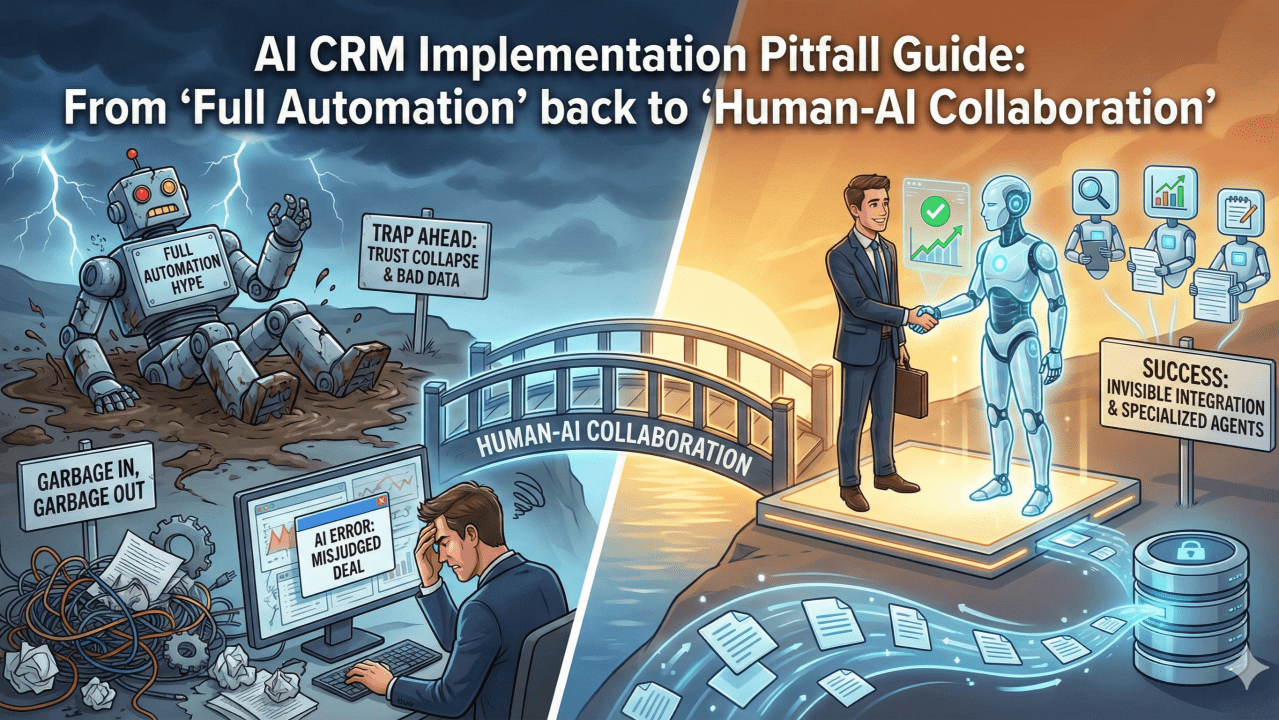
Roadblocks: Three Invisible Traps in B2B AI Implementation
Why do tools like ChatGPT or Gemini work smoothly for individuals, but struggle once they enter enterprise workflows?
The Answer: Because B2B fundamentally has a different requirement for AI.
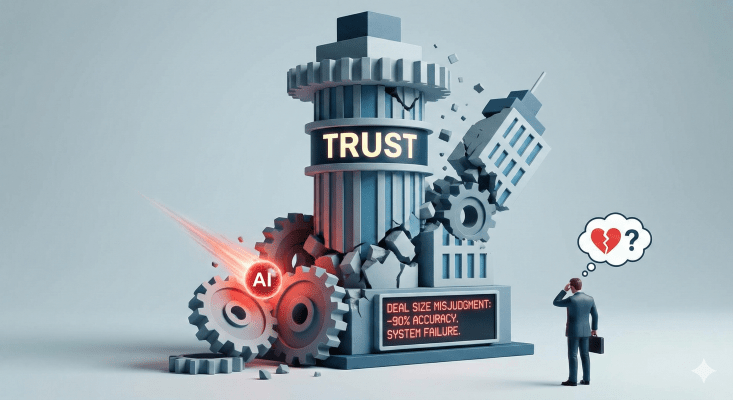
Trap 1: Trust Collapse – Consumers Can Tolerate AI Errors, Enterprises Cannot
When AI makes things up in consumer chat, or returns a goofy picture, people laugh it off. But in the B2B world, trust is currency.
If AI makes even a single mistake misjudging deal size, or misapplying discounts in automated price authorization, the salesperson’s trust in the system collapses instantly.
90% accuracy is not enough for enterprise software.
As long as this 10% risk exists, frontline employees will not trust AI with critical decisions nor are they able to hand off tasks to autonomous agents without checking. This is the reason why advanced intelligence analytics tools end up rarely being used – no one is willing to take a risk on that error probability.
Trap 2: Non-Standardization – Every Company Has Its Own Vocabulary
General-purpose large models are knowledgeable, but they don’t understand your internal jargon.
For example, Key Account might mean:
- Companies with annual revenue over USD 100 million in Company A
- Fortune 500 subsidiaries in Company B
When enterprises directly apply generic models, AI behaves like a fresh graduate intern. They know many principles but lack business context.
The result: AI’s recommendations are technically accurate, but are completely unusable in real scenarios.

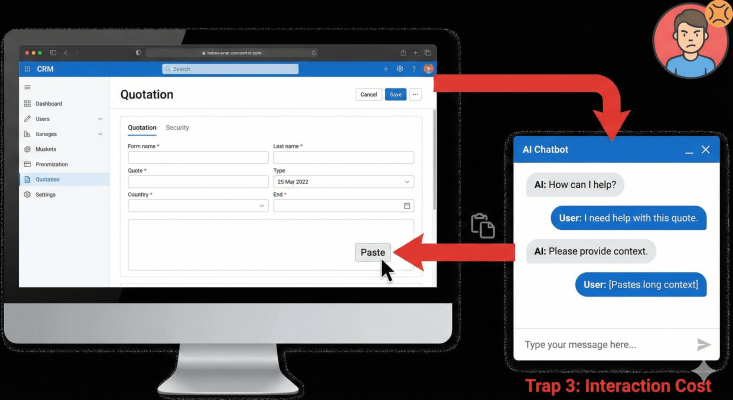
Trap 3: Interaction Cost – AI Shouldn’t Be a Popup Window
Many early AI CRM designs were lazy: we will just slap a chatbot icon in the bottom-right corner.
Imagine this workflow:
- Sales is filling out a quotation
- Needs AI help
- Close the quotation → open chat → re-explain the context → copy AI output → switch back → paste
These steps may seem trivial, but in high-pressure sales work, it could be disastrous.
If AI’s convenience doesn’t outweigh the cost, users will instinctively resist it.
Breaking Through: Three Practical Solutions to Bring AI Back to Reality
So should we give up on AI? Of course not.
Based on Neocrm’s own practices, and learning from other AI-native CRM products, we’ve summarized a practical ‘Pitfall Traps To Avoid’ guide.
The underlying logic is simple: Don’t aim for one giant leap. Focus on refined execution.
Solution 1: From ‘Full Automation’ back to ‘Human–AI Collaboration’
To address the potential collapse in trust, the solution is actually very simple:
Acknowledge AI’s imperfections and return the decision-making to humans.
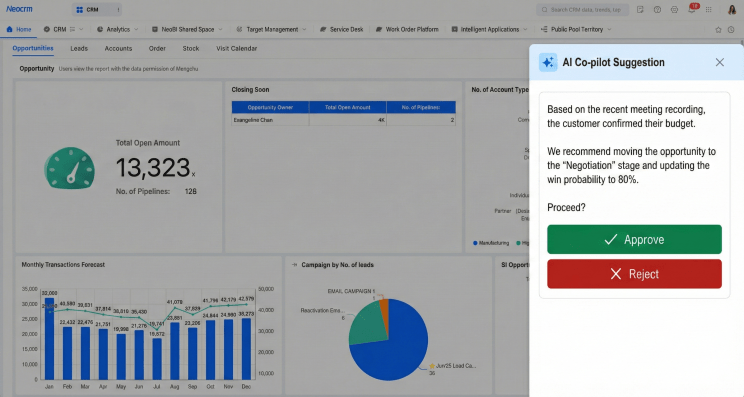
In complex B2B deals (opportunity stage changes, win-rate predictions, etc) do not expect AI to be fully in the drivers seat. The safest approach is co-pilot mode.
❌ Wrong Approach: AI hears the customer say “budget is fine” in a meeting recording, then automatically:
- Moves the opportunity from “Validation” to “Negotiation”
- Updates win probability to 80%
✅ Right Approach: AI detects the signal and pushes a suggestion:
“The customer confirmed budget during the conversation. We recommend moving the opportunity to the Negotiation stage. Proceed?”
System pauses for 10 seconds to confirm and the salesperson clicks “Approve.”
This leverages AI’s signal-detection strength while preserving human judgment. Let AI propose; let humans decide. This is the fastest way to build trust.
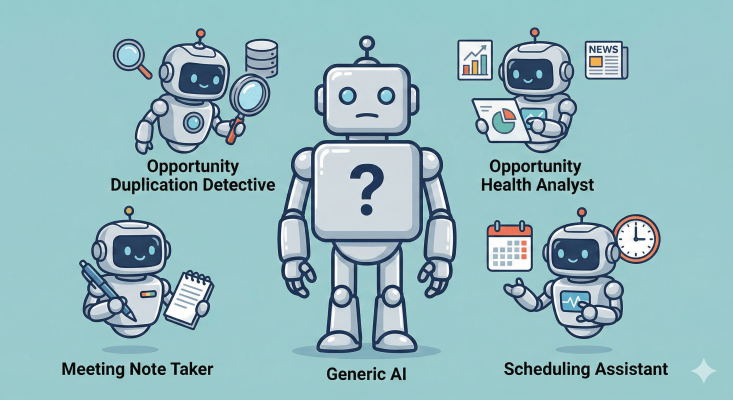
Solution 2: Specific Scenarios with Small, Specialized Agents
To overcome non-standardization, don’t build an omniscient AI. Build specialized agents for specific needs.
In Neocrm’s AI CRM, instead of a generic sales assistant, we train focused expertise:
- Opportunity Duplication Detection We feed AI years of sales operational logic data (group–subsidiary relationships, abbreviations, aliases) and combine semantic understanding with keyword matching. AI can identify that a subsidiary and holding company with a totally different name belong to the same account, accurately flagging conflict risks.
- Opportunity Health Insights AI is trained on sales methodologies, management SOPs, and historical follow-ups. Combined with real-time external data (customer news, competitor interactions, etc.), it weighs multiple factors and may advise: “Although internal notes indicate a strong relationship, the customer just issued a profit warning and a subsidiary has just signed a partnership with our competitor. Recommend lowering win rate to 40%”
The more specific the scenario and the clearer the domain the AI is operating in, the more it behaves like a subject matter expert and not a generic chatbot.
Solution 3: Invisible Integration – From Chat Windows to Ambient Intelligence
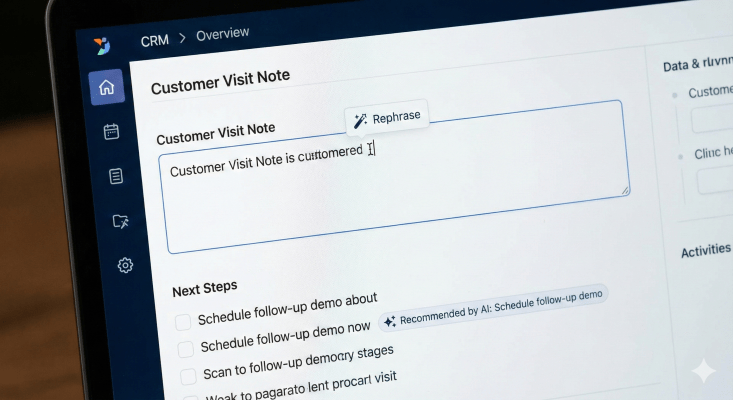
To reduce the interaction cost and overhead, AI must be embedded into workflows and the user experience.
True AI-native design isn’t just adding another chat window, it’s centered around intelligent UI elements.
Example:
- While writing the customer visit notes, instead of chatting with AI, users see a ‘Rephrase’ or ‘Expand’ button directly in the input field
- On the opportunity detail pages, AI-recommended next actions appear directly beside the ‘Next Step’ field
The best AI experience is zero awareness.
Users aren’t using AI – they are just doing their work, and data gets filled automatically and suggestions appear naturally.
A Shift in Perspective: From Managing People to Helping People
The global SaaS industry is shifting from:
- Software as a Service to
- Service as Software to
- Results as a Service
Many salespeople view CRM as a control tool – used to manage processes and audit work. It is no surprise that it continues to meet resistance:
“Is this just another system that makes me fill in more forms?”
AI gives enterprises a chance to redefine this relationship.
What we have also observed in practice, is that companies with smooth AI adoption have changed their messaging from management-first to enablement-first. Let us compare these two narratives:
- Compliance-focused “We introduced AI to analyze call recordings and ensure scripts are followed”
- Win-win focused “We introduced AI to auto-generate long meeting notes, extract customer pain points from massive data, and save you time so you can meet more customers and increase your win rate”
When AI is positioned as a personal digital assistant for sales, adoption becomes voluntary.
AI grows on data, but high-quality data comes from frequent usage.
Only when customer facing staff feel AI is helping rather than burdening them will they input real, valuable data – creating a positive feedback loop.
So, at the start of an AI CRM implementation, ask one important question:
Does this feature immediately benefit the the sales/service teams?

Final Thoughts
If you ask me what the biggest obstacle to enterprise AI adoption is, it’s not that models aren’t smart enough, but that:
- Our scenario granularity is too coarse
- Our Human-AI relationship design lacks fluidity
If we invest in refining the last-mile experience, AI can be deployed successfully.
However, even after optimizing scenarios, integrated user experience, and enabling collaboration, you may still find AI confidently producing wrong answers.
That leads us to the deepest truth of AI implementation, and the ceiling of all digital transformation:
Data.
If you feed AI garbage, even the best model will output more polished garbage.
In the next article, we’ll tackle this most painful, unavoidable topic.


