
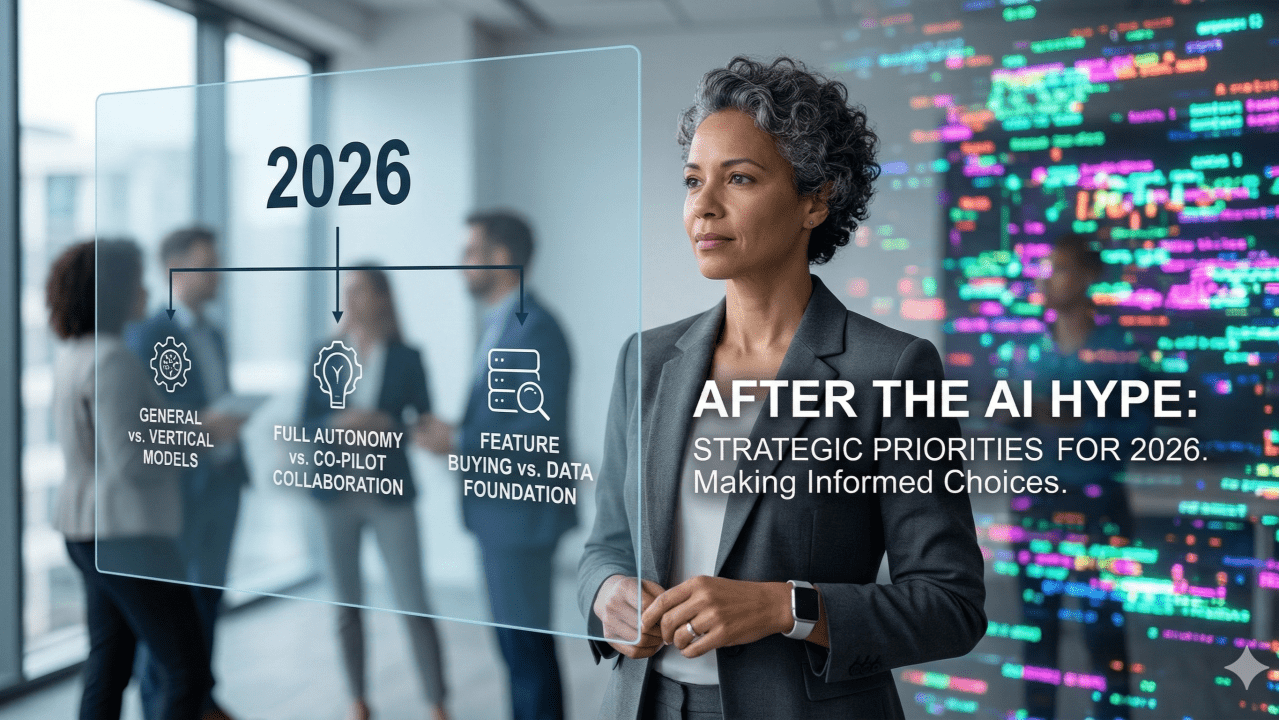
Neocrm Product Vice President / Luo Yi
Introduction
From the initial hype in 2023, to the confusion of 2024, and then to real-world implementation and disappointments in 2025 – AI is no longer a black-box technology confined to the headlines. It has become core infrastructure, flowing through the veins of an enterprise like water and electricity.
In the previous four articles of this series, we redefined AI-native CRM, identified high-value scenarios, dissected common implementation pitfalls, and explored the critical importance of data foundation.
As the concluding piece of this series, I want to talk about something more practical: when AI becomes a standard requirement, the real challenge for the enterprise shifts to how to select and where to invest. The decisive factor in 2026 will be whether organizations can remain clear-headed amid the hype and make precise and informed decisions.

The Reconstruction of SaaS Value – Toward Service as Software
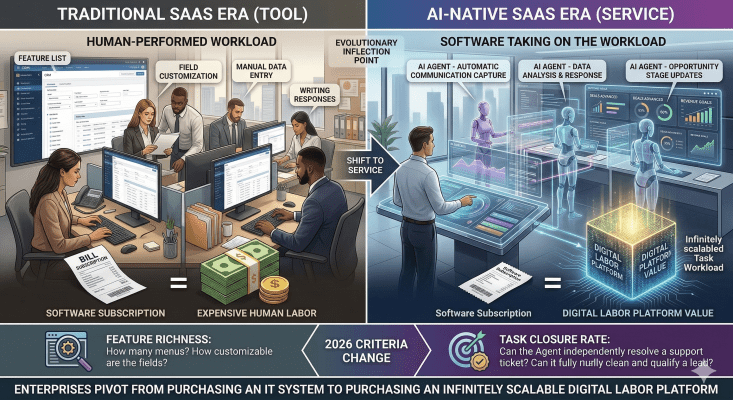
Globally we are witnessing a historic inflection point. SaaS is undergoing a profound evolutionary shift from tool-based software to service-based software.
This does not mean software disappears, but rather, its value proposition changes.
- Traditional SaaS Era (Tool): Software provides features; you hire employees, train them to use the software, and have them perform the work (updating CRM, writing follow-up actions, etc). Your cost = software subscription + expensive human labor
- AI-Native SaaS Era (Service): AI Agents are embedded in the software. You are no longer buying a customer data entry tool, but a service that helps advance deals. Software begins to deliver business outcomes directly (AI Agents automatically capture customer communications, analyze and send responses, then updates the opportunity stages). Your value = software taking on part of the human workload
This shift means that future CRM systems will no longer be a reporting system solely for managers, but digital employees capable of sharing frontline workload.
In 2026, the criteria for evaluating an AI CRM product will fundamentally change:
- From feature richness – How many menus? How customizable are the fields?
- To task closure rate – Can the Agent independently resolve a support ticket? Can it fully clean and qualify a lead?
Enterprises will pivot from purchasing an IT system to purchasing an infinitely scalable digital labor platform.
Strategic Trade-Offs: Three Critical Choices for Enterprises in 2026
Resources are always limited. In 2026, every dollar invested in AI must pass rigorous scrutiny and deliver real world benefits. Below are three of the most difficult and important choices.
Trade-Off 1: General-Purpose Foundation Models vs. Vertical Industry Models
Don’t re-invent the wheel but build the steering wheel.
In 2025, we saw countless unfinished foundation model projects. Many companies attempted to train their own sales-savvy LLMs, burning millions only to achieve results worse than a free update from OpenAI or DeepSeek.
Recommendation:
- Give up the illusion of building your own base model. General models are improving at a pace faster than Moore’s Law. You will never catch up.
- Double down on the last mile of business context. Your moat is not the model itself, but your private data, business logic and SOPs (Standard Operating Procedure). What you need is a platform that can flexibly connect to top-tier models while embedding your sales methodologies into the system.
Trade-Off 2: Full Automation vs. Human-AI Collaboration
Be wary of the allure of full autonomous agents. Bet heavily on super human individuals.
Radical innovative solution providers once envisioned a fully automated sales, but reality has proven that in complex B2B deals, trust cannot be fully replaced by code.
Recommendation:
- Give up the idea of letting AI negotiate on behalf of salespeople in high-value, long-cycle deals. Don’t let cold algorithms touch your most critical VIP relationships.
- Invest in strong, reliable co-pilot capabilities. Position AI as a strategist and logistics officer. The winners of 2026 will not be companies that replace sales teams with AI, but those that use AI to turn ordinary salespeople into superstars.
Budgets should prioritize:
- Intelligent knowledge Q&A and retrieval
- Customer and opportunity insights
- Real-time scripting and strategy assistance
Let sales devote 100% of their energy to relationship-building, becoming the trusted advisor to the customer and not just another salesperson.

Trade-Off 3: Buying Features vs. Buying Data Architecture
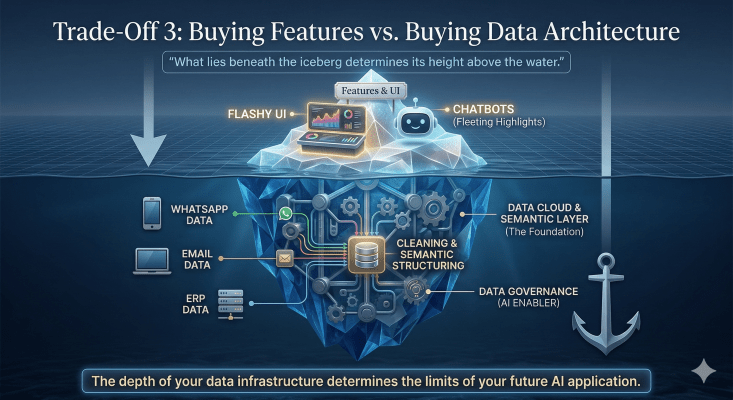
What lies beneath the iceberg determines its height above the water.
As discussed in the fourth article, without data governance, AI is just artificial stupidity.
Recommendation:
- Give up excessive investment in flashy front-end UI and cool-looking chatbots. Those are, at best, fleeting demo highlights.
- Invest heavily in Data Cloud and semantic layer construction. In your procurement discussions, the first question should not be “Can your AI write poetry?” but “Can your system automatically clean and semantically structure data from WhatsApp, email, and ERP?”
The depth of your data infrastructure determines the limits of your future AI application.
Budget Allocation Advice for CIOs and CEOs
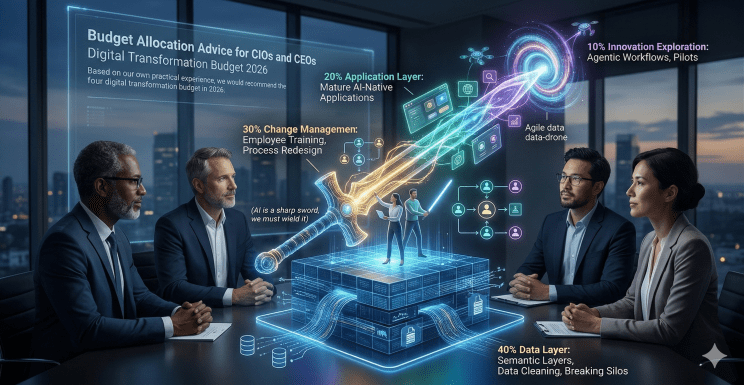
Based on our own practical experience, we would recommend the following for your digital transformation budget in 2026:
- 20% on the application layer: Purchase mature AI-native applications to quickly deliver frontline impact and address the ‘experience’ problem.
- 40% on the data layer: Build semantic layers, clean historical data, and break down data silos. This is the hardest work but delivers the highest ROI.
- 30% on change management: Often overlooked but substantial. AI is a sharp sword, and you must train employees to wield it, and even redesign sales processes and incentive structures.
- 10% for innovation exploration: Continuously evaluate emerging technologies like Agentic Workflows and run small-scale pilots.
Conclusion: Returning to the Essence of Business
From the concept of AI-native, to hands-on scenarios, to deep dives into data foundation, and finally to strategic trade-offs. We have tried to strip away the technological hype and return to business fundamentals.
For the past 30 years, due to various technological limitations, CRM was forced into the role of Customer Records Management, a greedy monster consuming frontline personnel time and energy.
Thanks to AI, CRM can now return to its original purpose in delivering Customer Relationship Management by:
- Entrusting memory to databases
- Entrusting reasoning to large models
- Entrusting trivial work to Agents
- Returning warmth, trust, creativity, and decision-making to humans
This is the vision of Neocrm’s AI-native CRM, and the future all enterprises should embrace in the Digital 3.0 era.
The road may be long, but perseverance will get us there. The task may be hard, but action will ensure success.
We hope everyone in 2026 finds their own path in breaking through with AI, crossing that critical threshold from imagining the possibilities to realizing business value.


