
Why Growing Companies Outgrow Basic CRM Target Management
For many companies, sales target management starts simple.
A CRM system is used to track opportunities, generate forecasts, and measure revenue performance for each sales representative. Targets are often defined as a single revenue number per salesperson or per team.
However, as businesses scale, sales structures become significantly more complex.
Companies begin to operate across multiple:
- Product lines
- Geographic regions
- Industry segments
- Sales teams
- Channel partners
At this stage, many organizations discover that basic CRM target management is no longer sufficient.
Instead, they need a more advanced approach: Multi-Dimension Target Management.
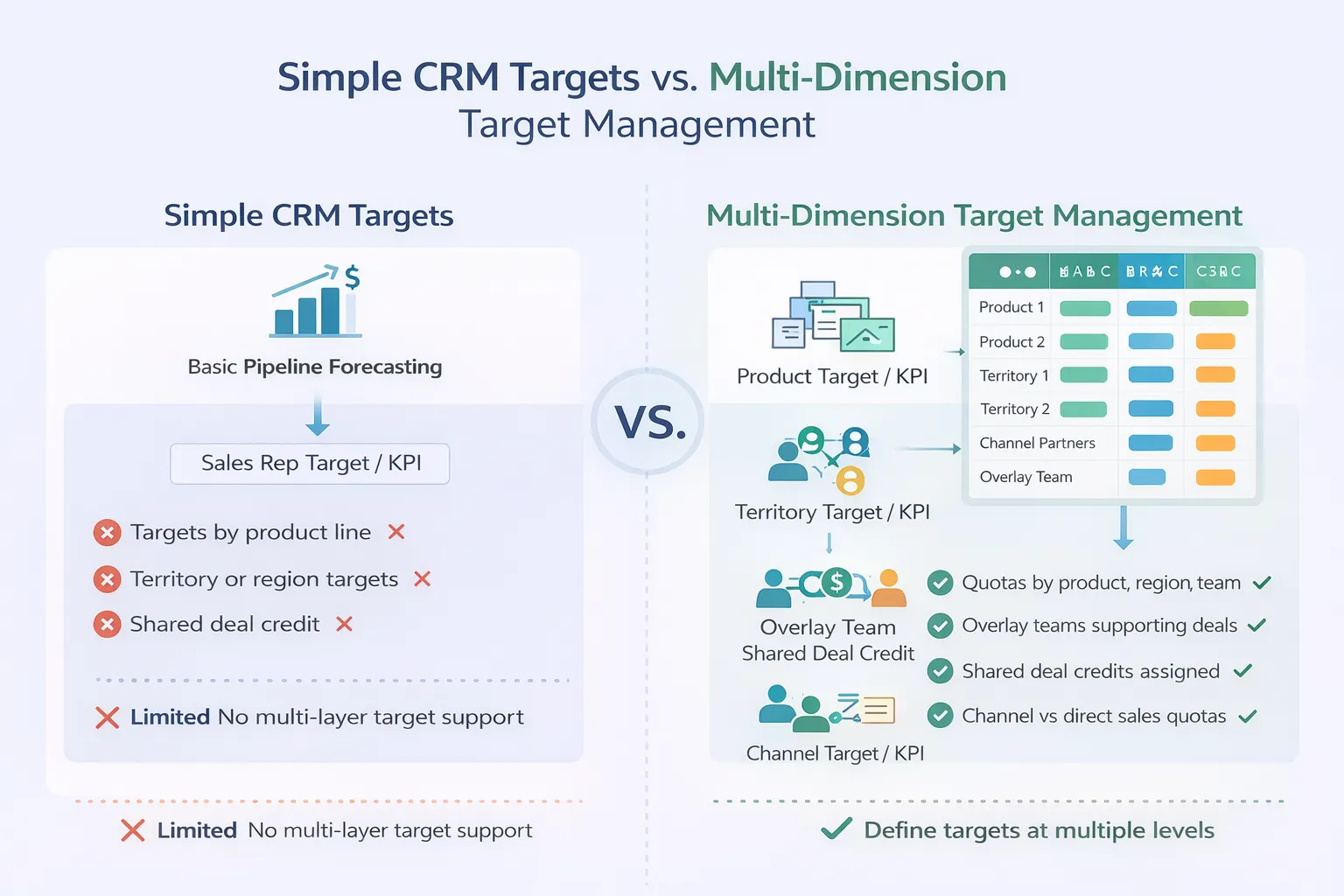
The Limitation of Basic CRM Sales Targets
Many lightweight CRM platforms provide only simple target management features.
Typically, sales targets are assigned in a flat structure such as:
- Annual revenue target per sales rep
- Quarterly team quota
- Forecast vs target comparison
While this works for small teams, it quickly becomes difficult to manage when sales performance needs to be tracked across multiple dimensions simultaneously.
Common limitations of basic CRM target systems include:
- Targets can only be assigned at one level (usually per salesperson)
- No support for product-level quotas
- Limited ability to track regional performance
- Difficult to analyze performance across industries or channels
As a result, many sales operations teams end up managing targets in complex spreadsheets outside the CRM, which leads to:
- Data inconsistencies
- Manual errors
- Lack of visibility for leadership
- Time-consuming reporting processes
Introducing Multi-Dimension Target Management
To address these challenges, modern CRM platforms introduce Multi-Dimension Target Management.
This means organizations can structure sales targets based on how the business actually operates.
Typical dimensions include:
Business Dimensions
- Product Line
- Industry
- Geographic Territory
- Sales Team
- Channel Partner
- Strategic Account
Time Dimensions
- Year
- Quarter
- Month
- Week
By combining these dimensions, companies can create a multi-dimensional sales target model that better reflects real-world sales operations.

Multi-Dimensional Target Configuration
With multi-dimension target management, targets can be defined across multiple dimensions and organized into a tree-like structure.
For example, a sales manager might define targets across:
- Product Line
- Industry
- Region
Together with time-based dimensions such as:
- Year
- Quarter
- Month
This creates a structured target hierarchy where performance can be monitored from different perspectives.

Why This Matters for Sales Leadership
For sales leadership teams, multi-dimension target management provides significantly better visibility into business performance.
Instead of asking questions such as:
- Which regions are performing best?
- Which product lines are underperforming?
- Which industries are generating the most revenue?
Leaders can instantly see these insights through built-in dashboards and reports.

Managers can also drill down into specific segments to understand where additional resources or strategic adjustments may be required.
When Companies Outgrow Basic CRM Target Management
Many companies initially adopt lightweight CRM platforms because they are easy to implement.
However, as sales teams grow and revenue structures become more complex, organizations often encounter limitations such as:
- Difficulty managing quotas across multiple product lines
- Lack of visibility into regional performance
- Heavy reliance on spreadsheets for commission calculations
- Manual reporting for sales leadership
This is usually the point where companies begin looking for CRM systems that provide enterprise-level sales performance management capabilities.
Matrix quota management is one of the key capabilities that enables organizations to scale their sales operations effectively.
Managing sales targets across multiple products, regions, and teams requires more than basic CRM functionality.
With Multi-Dimension Target Management, organizations can:
- Define sales targets across multiple dimensions
- Track deal contributions accurately
- Gain deeper visibility into performance
- Align incentives with business strategy
For growing sales organizations, this approach helps transform sales target management from a manual reporting process into a strategic performance management system.


