
And What Growing Businesses Should Consider
As businesses grow, pricing models often become more sophisticated. What starts as a simple price list quickly evolves into a combination of discounts, bundles, contract pricing, and channel-specific rates.
While many CRM systems work well for basic sales tracking, they often struggle when pricing becomes more complex. For organizations operating across multiple products, regions, and sales channels, managing pricing inside the CRM can become a major operational challenge.
In this article, we explore why complex pricing frequently breaks traditional CRM systems — and what capabilities businesses should look for when evaluating a CRM platform.
The Reality of Enterprise Pricing
Many CRM platforms are designed for simple sales processes:
- A product catalog
- A fixed price list
- A manual discount field
This approach works well for small sales teams with straightforward pricing models. However, real-world enterprise sales are rarely that simple.
Organizations often require pricing structures such as:
- Bundle pricing for product packages
- Volume-based or tier pricing
- Contract-specific pricing for large customers
- Distributor or channel partner pricing
- Region or currency-based pricing
- Approval workflows for discounts
When these requirements arise, many companies discover that their CRM system cannot support them effectively.
Instead, pricing calculations end up being handled outside the CRM — often in spreadsheets.
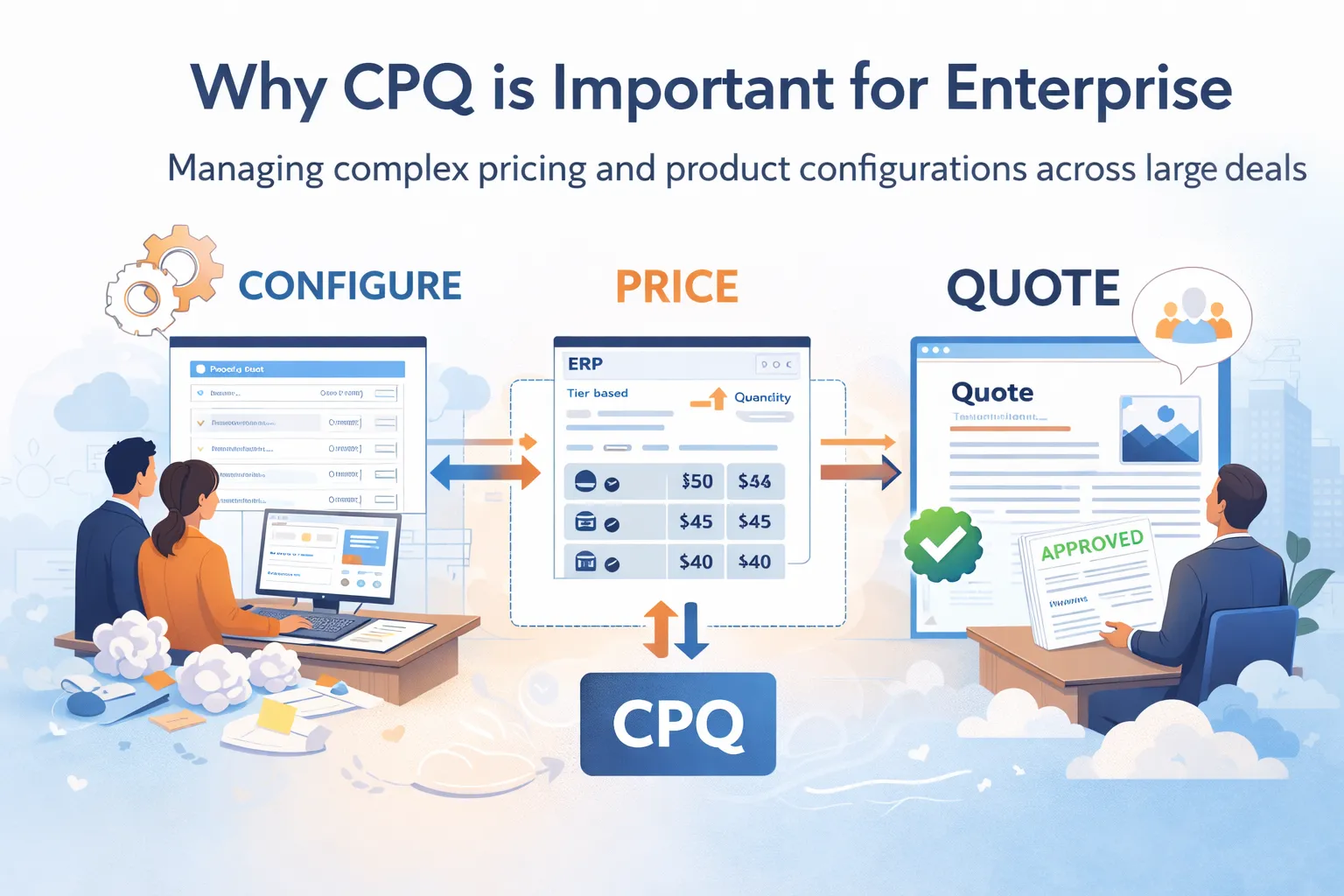
When pricing logic moves outside the CRM into Excel or other external tools, several operational issues quickly arise. Manual pricing calculations increase the risk of errors such as incorrect discounts, outdated price lists, or missing approvals, which can lead to revenue leakage. At the same time, companies lose proper pricing governance because approval processes are no longer centralized, making it difficult to track who approved discounts, whether pricing follows company policies, or how deals impact margins. In addition, scattered pricing logic often results in inconsistent customer quotations—for example, different sales reps offering different discounts or regional teams applying different pricing models—ultimately affecting both revenue control and customer trust.
How Different CRM Platforms Handle Complex Pricing
Many CRM tools available today focus primarily on pipeline management and sales activity tracking. These platforms work well for small teams but may struggle when pricing structures become more sophisticated.
The table below illustrates how different CRM platforms support CPQ-related capabilities.
| Capability | Neocrm | Zxxx CRM | Hxxxxxx CRM |
|---|---|---|---|
| Product configuration (CPQ) | ✅ Advanced configuration rules | ⚠️ Limited | ⚠️ Basic catalog |
| Bundle pricing | ✅ Supported | ⚠️ Partial | ⚠️ Limited |
| Tier / volume pricing | ✅ Supported | ⚠️ Limited | ⚠️ Limited |
| Channel / distributor pricing | ✅ Supported | ⚠️ Limited | ❌ |
| Automated pricing rules | ✅ Yes | ⚠️ Basic | ⚠️ Limited |
| Discount approval workflow | ✅ Built-in | ⚠️ Basic | ⚠️ Basic |
| Quote generation | ✅ Advanced | ✅ Supported | ✅ Supported |
| ERP pricing integration | ✅ Open API | ⚠️ Via connectors | ⚠️ Via integration |
✅ Full capability
⚠️ Partial / limited capability
❌ Not supported
As shown above, most lightweight CRM platforms provide basic quotation tools but lack advanced CPQ capabilities required by larger organizations.
Example: Configuring Complex Product Pricing
In many industries, sales teams need to configure products before generating a quote.
For example, a company selling industrial equipment may need to configure:
- Product model
- Optional components
- Service packages
- Installation services
- Warranty extensions
Each option may affect the final price.

With a structured CPQ setup, the CRM automatically calculates pricing based on selected configurations. This eliminates manual pricing calculations and ensures consistency across sales teams.
Managing Discount Rules and Approvals
Another important capability is controlling discount levels through automated approval workflows.
For example:
- Discounts under 10% may be automatically approved
- Discounts between 10–20% require sales manager approval
- Discounts above 20% require finance approval

This ensures pricing flexibility while maintaining governance.
Promotion Configuration for Flexible Pricing


In the example above, the promotion rule automatically applies when a customer purchases a specified quantity of a product. The system handles the calculation and applies the promotion consistently across quotations/orders. This eliminates manual adjustments by sales teams and ensures promotions follow predefined business rules.
With promotion configuration built into the CRM, organizations can maintain better control over promotional campaigns while ensuring pricing accuracy and consistency across all sales channels.
Generating Professional Quotations
Another challenge with complex pricing is producing accurate and professional quotations quickly.
A CRM with built-in quotation generation allows sales teams to:
- Automatically populate product pricing
- Apply correct discounts
- Generate formatted quotation documents
- Track different quote versions

This significantly improves efficiency and ensures consistency in customer communication.
Pricing is one of the most critical elements of any sales process. Yet many CRM systems were originally designed for simple pipelines rather than complex pricing structures.
As businesses grow, managing pricing inside the CRM becomes essential for:
- Pricing accuracy
- Sales governance
- Operational efficiency
- Consistent customer experience
Organizations evaluating CRM solutions should carefully consider how well the platform supports complex pricing scenarios — not just basic sales tracking.
Because when pricing becomes complex, the CRM must be ready to support it.


