

Introduction
In the previous article, we explored the essence of AI-native CRM and proposed that it is not a simple stacking of features, but a paradigm shift centered on intent, from a passive system of record to a business partner that can understand, recommend, and even act autonomously. After understanding what it is, a more practical and urgent question naturally follows: “Where do we start?” Especially in the early stages, when budgets are limited and data foundations are weak, choosing the right entry scenarios often determines the success or failure of the entire initiative.
“With a limited budget and poor data quality, are there scenarios that are easy to implement, able to demonstrate AI’s impact and build confidence with our management?”
As a product leader, this has been the question I’ve been asked most frequently over the past year. AI is powerful, but it is not omnipotent. Blindly pursuing ‘fully automated sales’ often ends badly.
Through collaboration with CIOs, sales leaders, and digital teams across many enterprises, we’ve found that successful AI CRM projects rarely start with the grandest vision. Instead, they begin with business entry points that are easiest to generate positive feedback, letting AI first handle tasks that people find cumbersome and that are easy to validate – i.e. quick win scenarios.
In this article, drawing on Neocrm’s frontline experience in 2025, we summarize several core scenarios where AI-native CRM is currently easier to implement, as well as the common logic behind them.

Before introducing the specific scenarios, we need to align on one key concept: Enterprise AI adoption is not about having many scenarios, but about ensuring closed loops.
Through reviewing real-world cases from the past year, we found that AI scenarios that enterprises truly recognize and rapidly scale, all sit precisely at the intersection of high-frequency business pain points and technology sweet spots. To screen for such scenarios, we recommend using two measures.
The first measure is the business experience: Is this a high-frequency task that frontline employees perform every day? Can they immediately feel the impact on effort saved after AI intervenes? More importantly, can AI’s output (such as recommendations or drafts) directly translate into the next action, rather than merely staying on the screen?
The second measure is technology fit: Does the scenario fully leverage LLMs’ (Large Language Model) strengths in handling unstructured data (audio, documents, conversations)? Is there sufficient fault tolerance to allow human-AI collaboration (AI drafts, humans edit)? And is the implementation chain short enough, without requiring complex system integrations?
When a scenario satisfies both ‘improved business experience’ and ‘technology availability to support it’, AI stops being a forced extra task and becomes a natural lubricant embedded in the business process. Based on this, we identified the following four high value scenarios that were successfully proven in 2025.

Intelligent Content Generation – Freeing Sales from Clerical Work
Implementation difficulty: ⭐
What do salespeople hate most? Not making the calls, but the endless written updates needed AFTER the calls – follow-up notes, meeting minutes, customer emails, weekly reports, etc. Statistics show that over 30% of B2B sales time is wasted on these administrative tasks.
AI-native CRM can now perfectly play the role of a well-paid secretary.
- Automated Meeting Minutes When sales record customer meetings (with permission of course) or upload meeting recordings to the CRM, the system not only transcribes audio to text, but also automatically extracts key information based on sales methodologies – such as customer pain points, key decision makers, budget status, and next actions. What used to take 30 minutes of manual work can now be generated by AI in 10 seconds, with sales spending another 1 minute to review.
- Assisted Communication Content For example, when a salesperson needs to email a dormant customer, they no longer need to struggle with wording. By clicking a ‘Re-Engage Dormant Customer’ button in CRM, AI automatically generates a polite, personalized opening message or email draft based on the customer’s historical transactions and industry profile.
In this scenario, AI acts as a copilot: it generates drafts, humans decide and send. With human oversight, risk is extremely low and efficiency extremely high.

Intelligent Knowledge Q&A and Information Retrieval (RAG + LUI) – Enabling Sales Access To Knowledge and Data Anytime, Anywhere
RAG – Retrieval Augmented Generation
LUI – Language User Interface
Implementation difficulty: ⭐⭐
This is the most effective way to address slow onboarding, overly complex products, and difficulty retrieving data.
When sales are out in the field, they fear two things most:
- Products are too complex: In manufacturing, high-tech, or medical industries, SKUs can number in the tens of thousands, with overwhelming parameters. For example, when a customer asks, “Does this device support 5G bands?”, new hires struggle to flip through dozens of PDF pages.
- Data is hard to find: Wanting to quickly check remaining inventory in Jakarta hub last month or total payments from a key account last year often means navigating 5–6 menu layers in a mobile CRM app and configuring complex filters – a very difficult experience.
Today’s AI-native CRM can handle both static documents and live data.
- Conversational Document Search By feeding product manuals, technical documents, and historical Q&A into AI, sales can simply ask on their phones: “The customer operating environment is −20°C, which sensor products should I recommend?” AI instantly searches all documents, returns a precise answer, and provides source links for verification.
- Conversational Data Queries This reflects deep integration between AI and business systems. Sales no longer need to learn complex filters; they just ask in natural language: “List customers in Singapore with collections over SGD 50,000 last month,” or “Check real-time inventory for Product A”. AI accurately interprets intent, converts it into system queries, and retrieves CRM data as lists or charts.
Enterprise assets can be divided into knowledge and data. Previously both were static; but AI now turns them into real-time living experts and reports, dramatically lowering the barrier to information access.

Existing Customer Mining – Turning Dormant Data into Real Revenue
Implementation difficulty: ⭐⭐
This scenario directly generates incremental revenue and offers the clearest ROI calculation.
Many enterprises have tens of thousands of customer records in their CRM, but most remain dormant. Why? Poor data quality. Sales only enter basic information, rarely maintaining tags like customer preferences or latest update. As a result, marketing can’t target precisely, sales can’t find leverage for upsell, and massive datasets become mere digital garbage occupying storage.
Here, AI-native CRM acts as a data miner – it doesn’t create data, but cleans and activates it.
- Intelligent Profile Enrichment (auto-tagging) Internally, AI batch-scans historical unstructured data (visit notes, tickets, emails) to extract implicit traits such as ‘price sensitivity’. Externally, it connects to public sources to capture tender wins, financing events, executive changes, and hiring needs. Through real-time fusion of internal and external data, static business card info is upgraded into a dynamically updated 360-degree customer profile.
- Intelligent Customer Recommendations (cross-sell) Based on look-alike customer models, AI continuously calculates and proactively surfaces cross-selling opportunities. For example: “Customer A purchased this product over 6 months ago. Based on similar customer behaviour, the probability of purchasing premium maintenance services is 75%. Recommend contacting the customer now.”
AI-native CRM shifts from ‘people searching for information in systems’ to ‘information proactively finding people’, proving that AI is not just a cost-saving tool, but a revenue-generating tool.

Intelligent Insights and Alerts – Equipping Sales with Foresight and Experience
Implementation difficulty: ⭐⭐⭐
This is the most critical scenario for solving low win rates and inaccurate forecasting, and the key indicator of AI’s business depth.
In complex B2B sales, the hardest part isn’t execution, it’s judgment. Managers often ask if a big opportunity is really solid or why revenue promised suddenly slips at the end of the month. Frontline sales rely on heavily on experience, or in strength of their customer relationship. Furthermore, in large project-based sales, deal collisions are common, where two reps pursuing different departments of the same project under different names go undetected by existing CRM systems, resulting in serious internal friction.
AI-native CRM no longer looks at cold numbers only; it gains the ‘feel’ and intuition of a seasoned sales director.
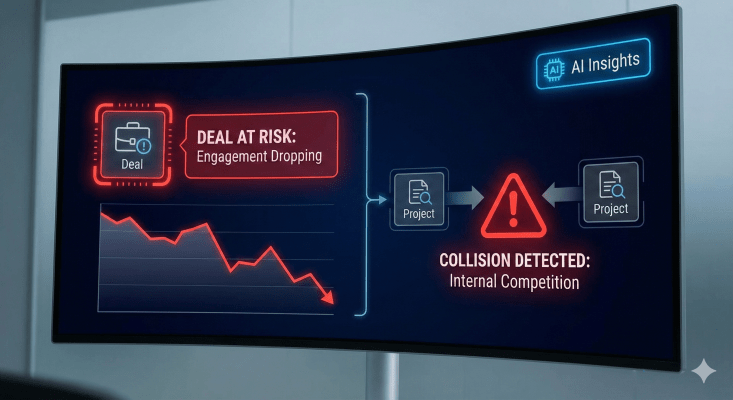
- Opportunity Health Checks By analyzing unstructured data signals such as email tone, attendance frequency of key decision makers, interaction intervals, instead of relying solely on manually filled stages and amounts, the system provides explainable alerts such as: “Although the opportunity stage shows 80%, the key decision maker (CEO) has missed the last three meetings, and email response times have slowed significantly. Intervention recommended”
- Intelligent Deal Collision Detection Using LLM (Large Language Model) semantic understanding instead of rigid ‘exact project name match’ logic, AI can infer true intent behind descriptions. Even if one project is called ‘Digital Transformation Phase I’ and another ‘IT System Upgrade’, similar business contexts trigger early collision alerts – avoiding internal competition and increasing alignment to better engage the customer.
From post-event recording to pre-event prediction, AI’s value lies in uncovering hidden correlation in data, shifting decision-making from reliance on personal intuition to data-driven intelligence.
Conclusion
By this point, you should have a concrete understanding of what AI can do. However, acute readers may notice that the fourth scenario has a three-star implementation difficulty. Why? Because it places much higher demands on data quality. This leads directly to the deeper topic of my next article: why some enterprises deploy AI but repeatedly fail due to an unreliable data foundation. We’ll break this down in detail in the next article.


