
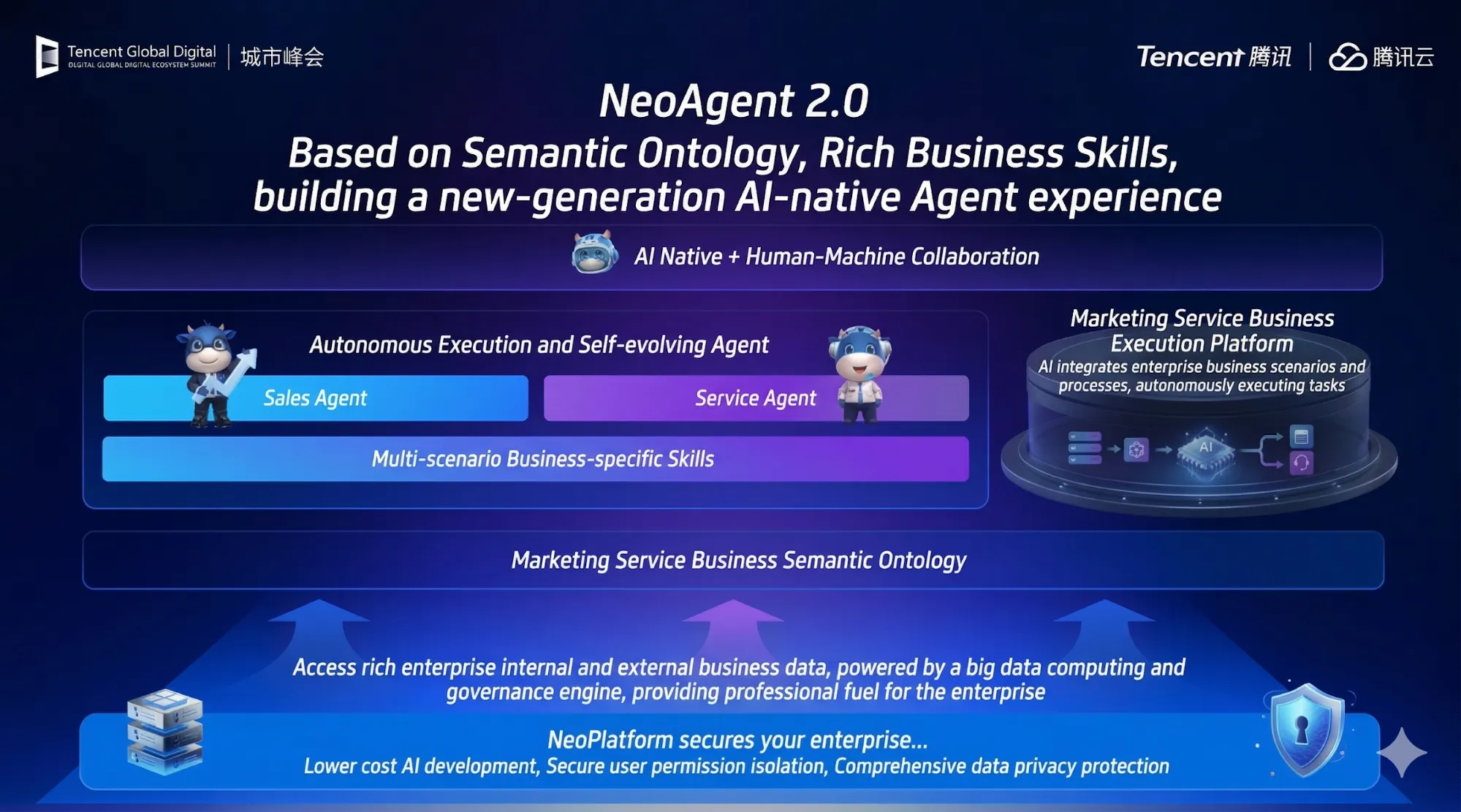
On March 27, at the Shanghai stop of the 2026 Tencent Cloud City Summit, Tencent-backed CRM provider Neocrm officially launched NeoAgent 2.0, a new generation of AI-native CRM for end-to-end marketing, sales, and service scenarios. The launch marks Neocrm’ transition from traditional CRM tooling toward AI-powered digital labor that can understand business context, take action autonomously, and deliver measurable growth outcomes. |
Overview
NeoAgent 2.0 is presented not simply as a product update, but as a new intelligent-agent product matrix built on a redesigned architecture. According to Neocrm, this release signals a major shift for CRM – from a management tool used to record activity into an enterprise-grade digital workforce capable of understanding context, executing work, and supporting business growth.
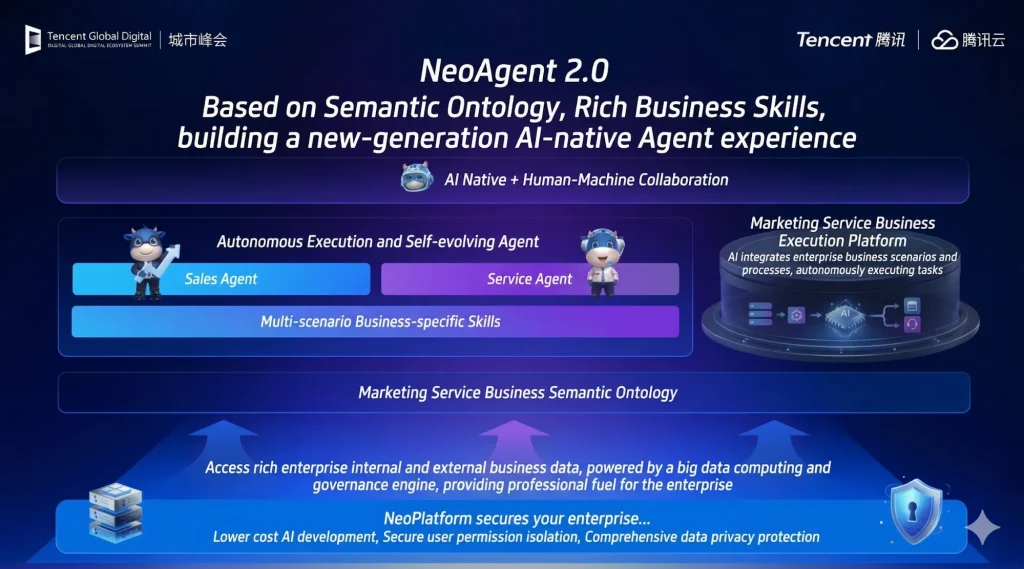
Following the launch of what Neocrm described as China’s first AI CRM in 2025, NeoAgent 2.0 introduces two core breakthroughs. First, it establishes a business semantic ontology that allows AI to understand the language of sales, service, and other complex business processes rather than merely processing code or structured fields. Second, it upgrades the platform to a Data for AI model, enabling all data generated during enterprise-customer interactions to be automatically captured, processed, and transformed into AI-ready inputs.
Built on these two foundations, NeoAgent 2.0 centers on autonomous execution. In Neocrm’ framing, the platform evolves from offering assistant-like recommendations to directly handling work, with measurable growth outcomes as the final deliverable.
Executive Positioning
Li Qiang, Vice President of Tencent Group, President of Government and Enterprise Business, and Chairman of Neocrm, said that AI CRM is approaching an inflection point and that market reshuffling has already begun. Leveraging deep collaboration with the Tencent ecosystem, Neocrm says it has built a full-loop capability spanning computing power, foundation models, and business scenarios. The company positions CRM as future relationship infrastructure for the intelligent enterprise era.
From Passive Recording to Autonomous Execution: Neocrm on AI CRM 2.0
Neocrm President Deng Yongfu argued that AI CRM 2.0 is not a functional patch on top of CRM 1.0, but a systemic reconstruction of both underlying logic and value delivery. In his view, it is not CRM with AI added on – it is CRM designed for AI from the ground up.
Neocrm describes this shift through three defining characteristics:
- Product form: from process tool to AI-native system. Instead of being built around forms and dashboards, AI CRM 2.0 is framed as an enterprise intelligent agent grounded in a business semantic model. It can proactively sense business changes, anticipate risks, recommend next actions, and automatically execute tasks that can be closed in a trusted and secure enterprise environment.
- Customer value: from feature delivery to outcome delivery. In the 1.0 era, customers bought functional modules. In the 2.0 era, Neocrm argues that customers will buy quantifiable business results. The company says it has already begun validating outcome-based pricing with several Fortune 500 clients.
- Business model: from point solutions to ecosystem collaboration. AI CRM 2.0 is positioned as an open, pluggable platform that works alongside cloud providers, large-model vendors, and industry ISVs. Neocrm says it is moving beyond per-seat pricing toward a hybrid model in which capabilities can be packaged, distributed, and monetized through skills and MCP-based components.
NeoAgent 2.0: From Assistant Tool to Digital Workforce
Luo Yi, Vice President of Product at Neocrm, said the core breakthrough in NeoAgent 2.0 lies in its business semantic model. Traditional CRM systems rely heavily on structured forms – orders, opportunities, and contracts are all forced into predefined fields. Yet large amounts of high-value information, such as meeting notes, emails, and WeCom conversations, remain outside that structure and are difficult for AI to interpret.
NeoAgent 2.0 is designed to unify both structured and unstructured data into semantic data that AI can understand. In Neocrm’ description, this allows AI to evolve from simply reading fields to genuinely understanding business context.
According to Neocrm, that architectural shift creates three layers of customer value:
- It understands business, not just keywords. For example, when a salesperson asks which opportunities are at risk, NeoAgent 2.0 can combine customer updates, communication history, and competitor intelligence to generate warnings and recommended actions based on context rather than isolated search terms.
- It can do work, not just offer suggestions. The platform is designed to handle tasks such as customer analysis, solution recommendations, ticket routing, and visit summaries, allowing sales and service staff to focus on relationship-building, closing deals, and serving customers.
- Its outcomes are measurable, not merely intuitive. Each AI action is intended to be traceable and quantifiable, allowing enterprises to evaluate how much lead growth, labor savings, and conversion improvement the system produces.
Neocrm argues that the significance of NeoAgent 2.0 extends beyond a product upgrade. By introducing business semantics into the underlying CRM architecture, the platform breaks the traditional limitations of structured-form CRM and turns conversations, documents, and emails into assets that can be analyzed and activated. In that sense, CRM evolves from recording what happened to understanding what is happening and predicting what may happen next.
Deep Tencent Collaboration: Three Sustainable Advantages
Deng Yongfu described AI CRM competition as a marathon rather than a sprint. In Neocrm’ narrative, Tencent provides the long-term foundation that enables sustained investment in product definition, scenario depth, and customer service.
The company says that in 2025 its strategic partnership with Tencent was comprehensively upgraded, deepening from capital-level support into close collaboration across technology, product, and business scenarios. Tencent Cloud infrastructure, the Hunyuan large model, Enterprise WeChat, and Tencent Meeting are presented as part of a complete loop from compute to model to real-world application.
Neocrm frames this advantage around three types of sustainability:
- Sustainable iteration capability. Backed by Tencent, Neocrm says it has stable support across capital, computing resources, talent, and technology, allowing it to pursue long-term AI CRM innovation with confidence.
- Sustainably evolving models. Each Hunyuan model upgrade is said to strengthen Neocrm’ AI capabilities, while Neocrm’ experience serving hundreds of Fortune 500 enterprises feeds practical B2B know-how back into model improvement. The company describes this as a positive data flywheel in which models improve, products get better, and customer stickiness increases.
- Sustainably expanding scenarios. Through Tencent’s broader ecosystem – including marketing cloud capabilities, Tencent Meeting, and Enterprise WeChat – Neocrm says it gains an expanding set of environments in which AI can be tested, applied, and commercialized.
Toward AI CRM 2.0: Let Technology Serve Relationships
Neocrm closes the announcement with a broader philosophical repositioning of CRM. For the past two decades, CRM has often been interpreted as Customer Record Management – focused on information, processes, and sales funnels. In the AI era, the company argues, CRM can return to its original meaning: Customer Relationship Management – centered on trust, relationships, and human connection.
In this view, AI CRM 2.0 is not about replacing people with technology, but about using technology to empower people. It is not about turning customers into data, but about using data to understand customers better. It is not about hardening service into rigid workflows, but about using intelligence to amplify trust. Neocrm positions its long-term mission accordingly: rooted in industry, supported by Tencent, and committed to becoming the relationship infrastructure of the intelligent enterprise era.
Summary
Neocrm has launched NeoAgent 2.0 as its next-generation AI-native CRM platform, positioning it as a move from AI-assisted CRM toward AI that can understand business semantics, process both structured and unstructured enterprise data, and autonomously execute work. Backed by deeper Tencent collaboration, the company is framing AI CRM 2.0 as a new stage in which CRM shifts from workflow management toward measurable business outcomes and digital labor.


